
RALEIGH – North Carolina legislative leaders filed new briefs Friday defending laws that limit the governor’s choices for appellate court vacancies and redistribute appointment authority over state boards and commissions.
The filings are part of two separation-of-powers cases, Stein v. Berger and Stein v. Hall, scheduled for oral argument before the North Carolina Supreme Court on Nov. 10. Gov. Josh Stein, a Democrat, is challenging measures enacted by the Republican-led General Assembly.
One dispute concerns a 2024 law requiring the governor to fill a vacancy on the Supreme Court or Court of Appeals from a list of three people recommended by the departing judge or justice’s political party. A three-judge trial court panel blocked the provision, but the Court of Appeals reversed that ruling.
In their Oct. 9 brief, legislative leaders argue that the governor still makes the appointment and that the state constitution does not prevent lawmakers from defining the pool of eligible nominees. They contend Article IV, Section 19 identifies who fills appellate vacancies but does not give the governor exclusive authority to select nominees without legislative qualifications.
Stein’s lawyers have argued that the provision violates the constitution by restricting what they describe as the governor’s exclusive appointment power for appellate vacancies.
A second legislative brief addresses changes involving seven state boards and commissions. Lawmakers argue that shifting some appointments from the governor to other independently elected Council of State members does not violate separation of powers because the executive branch retains a majority of appointments on each board at issue.
The governor argues that the changes diffuse executive authority and allow politically aligned officials to reduce his control over agencies that carry out state law. The legislative brief responds that North Carolina has a plural executive branch and that the constitution authorizes the General Assembly to assign duties among Council of State members and organize state agencies.
The Supreme Court has set aside about two and a half hours for the Nov. 10 arguments. The new briefs do not resolve either case; they present the legislative leaders’ position before the court hears the disputes.
Sources
- Legislative defendants’ brief on appellate judicial vacancies
- Carolina Journal report on the Oct. 9 filings
- Legislative defendants’ response brief on boards and commissions
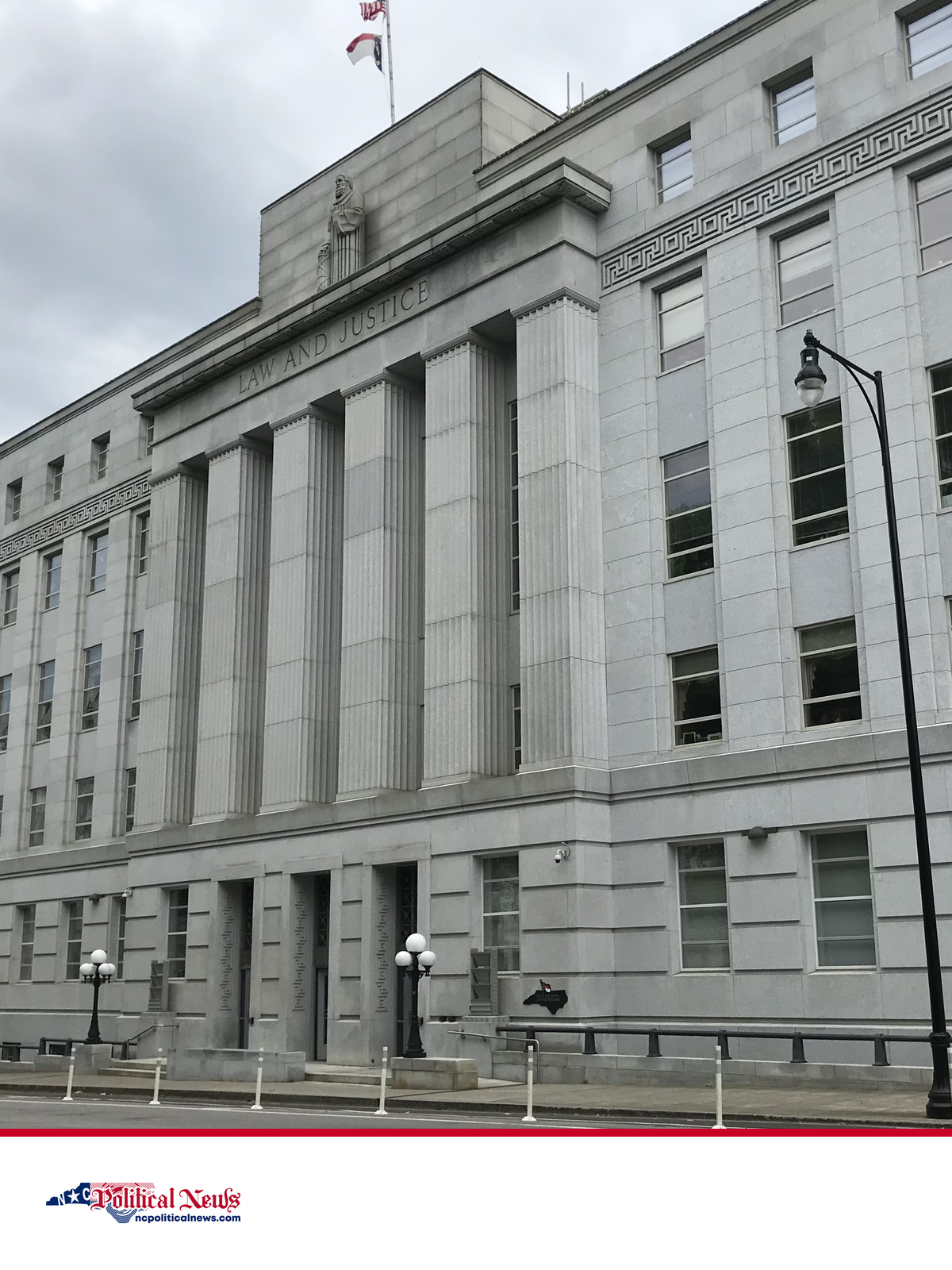
Photo Credit: Indy beetle via Wikimedia Commons; CC0 1.0 public-domain dedication. North Carolina Justice Building in Raleigh, photographed April 16, 2023. License: https://creativecommons.org/publicdomain/zero/1.0/
Editor’s Note: This article was drafted with the assistance of artificial intelligence and was reviewed and fact-checked by a member of the NC Political News editorial team before publication.