
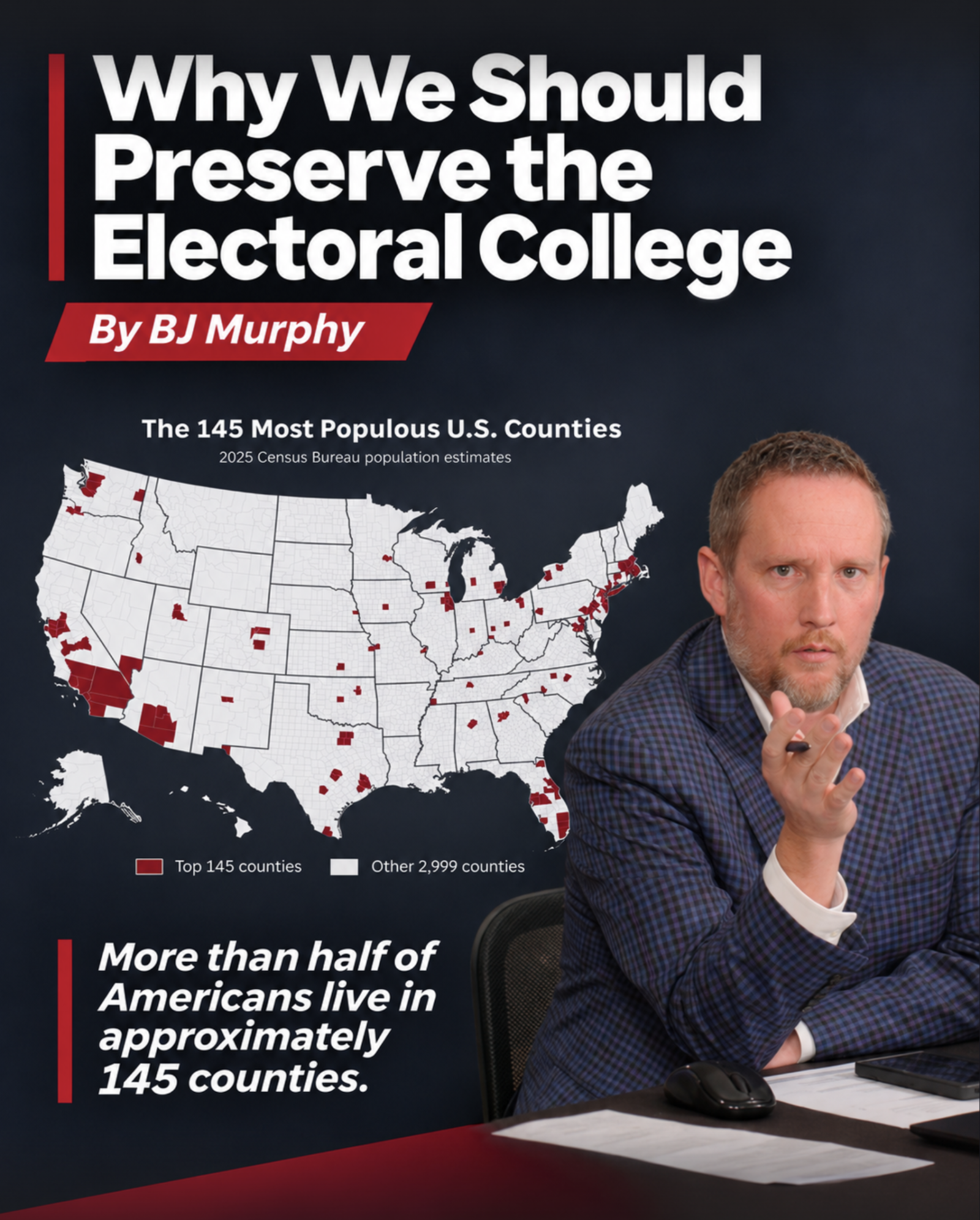
More than half of Americans live in approximately 145 counties. The other half are spread across nearly 3,000.
Following the November 3 elections, Democrats swept the United States House and Senate and made significant gains in state legislatures across the country. With those victories has come renewed discussion about potentially dismantling the Electoral College.
Before we give that any serious consideration, we ought to understand why our Founders believed representation required more than a simple majority.
America’s Population Is Not Evenly Distributed
Take a look at a map showing the population of our nation’s counties. A relatively small number of heavily populated metropolitan areas account for more than half of our country’s residents, while the other half live across thousands of communities.
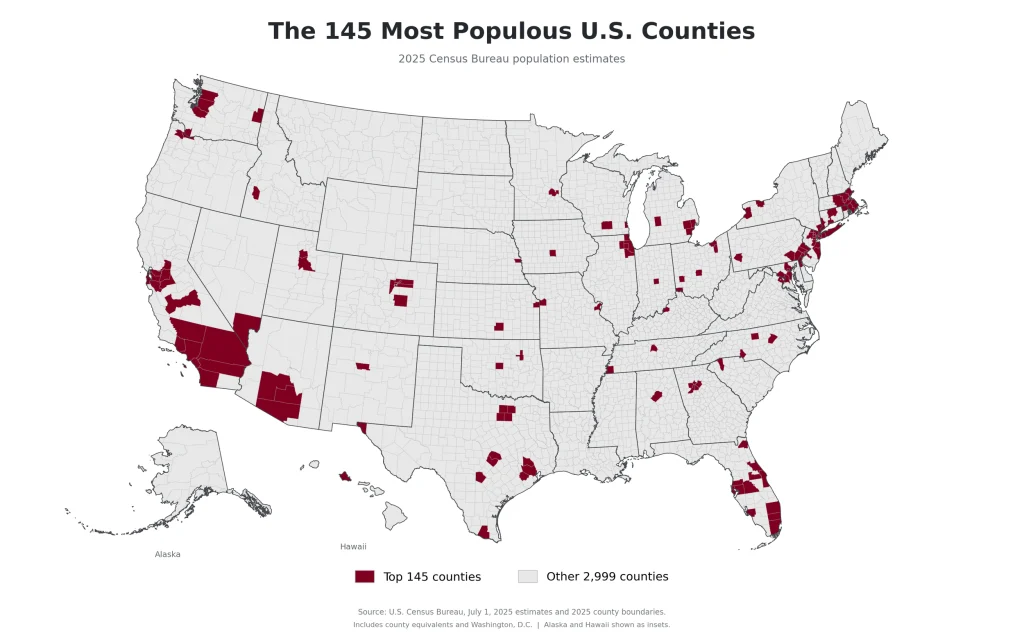
That geographic concentration raises an important question about political influence. If the selection of our president were determined exclusively by a national popular vote, how much influence could these population centers have compared to the thousands of smaller counties scattered across America?
The issues facing metropolitan areas are often much different from those facing rural communities. Consider Charlotte, one of our country’s major financial centers. Here in eastern North Carolina, much of our economy is rooted in farmland and agriculture. The policies affecting those industries, their workers and their communities can be dramatically different.
Neither is more important than the other, and both deserve consideration in the policies governing our country.
Our Founders Understood the Importance of Balance
Our Founders understood the importance of balance, and that wisdom is evident in the structure of our federal government.
Consider our bicameral legislature, where the House of Representatives represents the population and the Senate provides equal representation among the states.
The House is a body that introduces, debates and passes legislation, sometimes as though it has excess capital waiting to be spent. The Senate, by comparison, is intended to be a more deliberative body, where the legislative process slows down to allow for greater consideration before legislation reaches the president’s desk.
There is nothing inherently wrong with either approach. Both institutions have important responsibilities, and both must work together to develop policies that respect the interests of our country as a whole.
The Electoral College reflects a similar constitutional balance.
It is important that the population gets to vote, and it is also important that states play a meaningful role in choosing who represents them in the presidency. The Electoral College recognizes both population and state representation through the allocation of electoral votes.
Remember, we are the United States of America. Our states make up our federal system, not the other way around.
At our very core, the constitutional principle of federalism recognizes the importance of dividing governmental authority. Our federal government has responsibilities such as printing money, declaring war and managing foreign policy. Meanwhile, our state governments and local governing bodies, including county commissioners and public school boards, address many of the issues affecting our communities every day.
That division of power is intentional. It recognizes that the needs of our country are not always identical to the needs of an individual state or local community.
The View From Rural Eastern North Carolina
Here in rural eastern North Carolina, I see those differences firsthand.
The needs of our communities are often quite different from those of Charlotte, Raleigh, Durham and other major cities. The same can be said for western North Carolina, our beach and mountain communities and the countless small towns throughout our state.
Over the years, I have personally seen most of these presidents, vice presidents and presidential hopefuls right here in Kinston, North Carolina, a town of approximately 20,000 people: Bill Clinton, Bob Dole, Mike Pence, Donald Trump, Hillary Clinton, JD Vance, John McCain and John Edwards. I have also confirmed that Ronald Reagan stopped in Kinston in 1976.
Think about that. A small eastern North Carolina town has attracted presidential candidates and national political figures from both major parties.
I believe the Electoral College has helped give communities like ours a place in presidential campaigns, particularly when North Carolina is a competitive state. Without it, I worry there would be far less incentive for presidential tickets to campaign in rural America. Our communities deserve to be seen, heard and understood by those seeking the highest office in our country.
I would argue that both our urban and rural communities are equally important to the makeup of North Carolina. Neither should be dismissed simply because one has a greater population than the other.
The same consideration should inform how we evaluate the popular vote and the Electoral College. Each individual voter matters, and so does the constitutional role of the states in selecting our president.
Just as the House and Senate serve different functions within the legislative process, the Electoral College incorporates different principles of representation into the presidential election process. If we focus exclusively on one principle while dismissing the other, we risk losing an important part of the balance our Founders sought to establish.
More than half of our fellow Americans live in a relatively small number of counties, and the rest of us are spread across thousands of communities with different needs, challenges and perspectives.
The question isn’t whether the Electoral College produces the outcome we want in the next election. It’s whether changing this foundational institution would better serve all Americans for generations to come.
That deserves thoughtful deliberation, not a reaction to the political fortunes of either party.
I believe preserving the Electoral College, rather than dismantling it in response to the politics of the moment, is the better course for a nation as geographically, economically and culturally diverse as ours.
BJ Murphy is a Lenoir County commissioner-elect and former two-term mayor of Kinston, North Carolina. He is president of Magic Mile Media, Inc., the parent company of NC Political News and Neuse News.